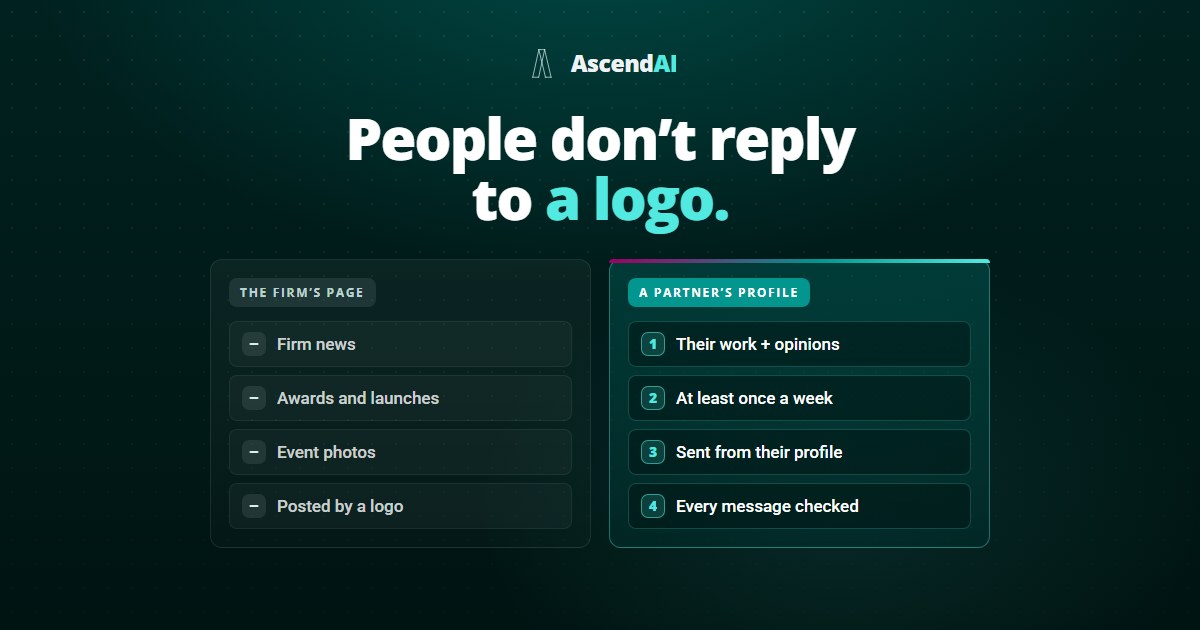
- People want to talk to a person, not a company page. In our own data, posts from a person get far more views than posts from a company page, start far more conversations and bring in far more leads.
- A senior partner's profile has trust built in. One good, well-timed message from a partner to another executive can get a meeting that a junior sales rep would spend weeks chasing.
- Post in their voice at least once a week: their work, their opinions and the skills they have in their niche, drawn out by interviewing them.
- Across 2,279 of our own LinkedIn conversations, cold messages got replies about 13% of the time, researched cold messages about 25% and warm messages 57%. A person checks every message, every conversation goes into a CRM, and you count meetings, not replies.
Most firms that try LinkedIn start with the company page, where they post firm news, a few awards and the odd event photo. A company page is good for your brand, but people don't want to talk to a company. They want to talk to another person.
This is very clear in our data. Posts from a person get far more views than posts from a company page, they start far more conversations and, in the end, they bring in far more leads.
That's why step 4 of winning clients beyond referrals is to run a senior person's LinkedIn as a sales asset. That means three things:
- Content in their voice
- Messages from their own profile
- Every message researched with AI, checked and tweaked by a person
Why a senior person?
It comes down to trust and credibility.
Think about how a junior sales rep gets a meeting with a senior executive. They have to email the firm, try to phone them and get past the gatekeeper, and it's a huge amount of work that mostly goes nowhere.
Compare that with one good message, sent at the right time, from a senior partner to another executive. If it's well written and it really sounds like them, the chances of opening that door are very high, and it can get you a meeting very quickly. The partner already has the credibility, and LinkedIn just lets them use it.
What does content in their voice look like?
What to post
A partner should post about their work, their opinions and the skills they have in their niche, and not really about firm news. A repost of the company's post once in a while is fine, but people want to know about them: why they can trust them, that they're good at their work and what they stand for.
How often
At least once a week. Some people post far more often and it also depends on your market, but once or twice a week is fine.
How to get their voice
You have to interview them. Senior people are busy and they won't write their own posts every week, so you sit down with them, listen to how they speak and guide them with really good questions about what they should be talking about. Good questions bring out real stories and real opinions, and those become the posts.
What bad partner content looks like
- It isn't there. No posts at all, or the last one was a year ago.
- It's only reposts of the company's posts.
- It does the company page's job: firm news, awards and launches.
- It's too personal: walking the dog on the beach, or the gym session.
What do messages from their own profile get?
This is where the content pays off. We went through 2,279 of our own LinkedIn conversations, and here's what the replies looked like:
- Cold, with a good message: about 13% replied. That's all replies, not just the positive ones.
- Warm: 57% replied.
- Cold, but properly researched: about 25%, which is nearly double, just from doing the homework.
What "warm" means
Warm means there's already been some kind of touchpoint. They've connected with you, they've seen your posts or they've liked one of them. This is why the content matters, because every post makes more people warm before you ever send a message, and warm is much easier.
Warm also covers the leads you already have. Most firms have company leads from other channels, usually inbound, that typically sit inert in Mailchimp or something like it. Enrich them, find each person's LinkedIn profile and then send them a warm message. They already know the firm, so it's a much easier conversation to start.
What "researched" means
You look into the company and the person before you write, so the message is about them and not about you. One real detail about their business does more than a whole paragraph about your firm.
Why is every message checked by a person?
We're an AI-native firm, and AI does a huge amount of the day-to-day work of running our business. But we're very careful with it, and every message is reviewed by a person before it goes out.
AI can't be relied on 100%, and a message from a partner's own profile carries their name, so one wrong detail costs far more than a slow day. AI drafts and a person decides.
Then track every one
Getting warm leads isn't enough, and getting sales-qualified leads isn't enough either. Every conversation has to go into a CRM, where you track the meetings, the losses and the reasons for the losses. (We covered why in part 2.)
And count meetings, not replies. In our data, one campaign got replies 13% of the time and another got 36%, yet both landed about 9 meeting conversations per 100 messages.
It all comes back to data. Sales is a data game.
One thing to do this week
Open the LinkedIn profile of your most senior partner and look at their last 10 posts. How many are about their own work and opinions, and how many are reposts, firm news or holiday photos?
If it's mostly the second group, or there are no posts at all, that's where to start.
The bottom line
People reply to people, not logos. A senior partner's profile has trust built in, and one good message from it can do what weeks of chasing can't.
So post in their voice at least once a week, and send researched, personal messages from their own profile. Have a person check every one, then put every conversation into a CRM and count the meetings.
Which of these is true at your firm?
- A senior partner posts at least once a week
- Those posts are about their work, not firm news
- First messages go out from their own profile
- A person checks every message before it's sent
- Every meeting and every loss is in a CRM
Join us on 26 November
On Thursday 26 November at 09:00 UK, I'm hosting a 45-minute online roundtable for partners and leaders of professional services firms. There are only a few places left. I'll walk through the engine that wins clients beyond referrals, stage by stage, and where AI now does the work. Then we compare notes. Free, up to 15 places, each checked by hand. If 26 November doesn't suit, there's another session on 10 December.
Request a place →Originally published in Sean Winter's newsletter, as part 4 of the Beyond referrals series. Part 1: why referrals slow down. Part 2: you can't manage what you don't measure. Part 3: how many clients could you actually have?
Frequently asked questions
Why should a professional services firm use a partner's LinkedIn profile instead of the company page?
A company page is good for the brand, but people want to talk to a person, not a company. In AscendAI's own data, posts from a person get far more views than posts from a company page, start far more conversations and bring in far more leads. A senior partner also has trust and credibility built in, so one good, well-timed message from their profile can get a meeting that a junior sales rep would spend weeks chasing.
What should a senior partner post on LinkedIn, and how often?
Their work, their opinions and the skills they have in their niche, not firm news. A repost of the company's post once in a while is fine. Post at least once a week; once or twice a week is fine. To get the posts in their voice, interview them: listen to how they speak and ask good questions, and the real stories and opinions become the posts.
What reply rate should LinkedIn messages from a partner's profile get?
Across 2,279 of AscendAI's own LinkedIn conversations, cold messages with a good message got replies about 13% of the time, cold messages that were properly researched got about 25%, and warm messages got 57%. Warm means there has already been a touchpoint: the person has connected, seen the posts or liked one, or is an inbound lead the firm already holds. Count meetings rather than replies: two campaigns with 13% and 36% reply rates both landed about 9 meeting conversations per 100 messages.

Sean Winter
Sean is a CFA charterholder with 20+ years in finance and professional services. He founded AscendAI to turn executive LinkedIn profiles into a predictable pipeline of C-suite meetings for professional and financial services firms across EMEA.