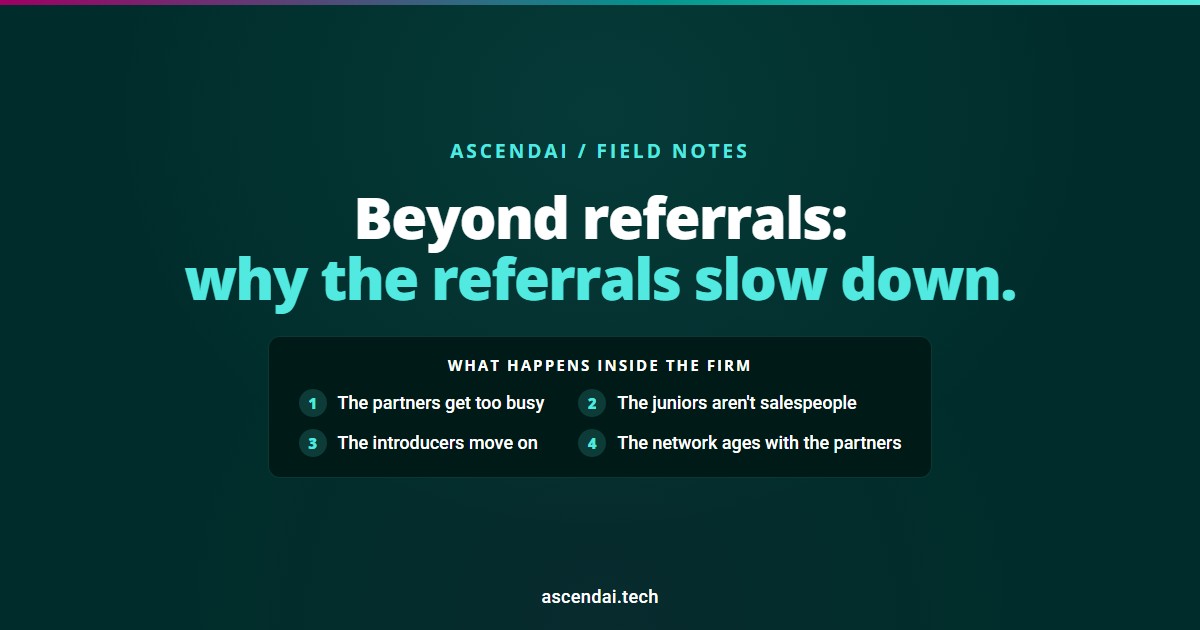
- Referral-built firms become delivery firms: partners get too busy, juniors have thinner networks, introducers retire and the network ages with the partners.
- A referral does most of the selling before the first meeting, so referral firms rarely learn to sell to a buyer who doesn't know them.
- With a cold buyer the outcome turns on your website, visibility, writing, follow-up, the first call and timing.
- Start by listing your last ten clients and where each came from. If most trace back to three or four people, build the second stream now.
When I speak to a managing partner, a CEO or an MD at a professional or financial services firm, I usually ask where their work comes from. Most of the time the answer is a referral, a former colleague or someone in their network.
That isn't a bad thing. In this line of work everything comes down to delivery. Deliver well, and people refer you, the brand builds and more work follows.
The trouble starts later.
Why do referrals slow down?
A firm that grows on referrals becomes, quite rightly, a delivery firm. The partners' diaries fill with client work, and new business arrives when an introduction arrives. Nobody can plan around that, because nobody knows when the next one will come.
Compare that with a software company. They track their sales numbers every day: where each lead came from, how many turn into meetings and how many sign. They can forecast next month's growth and manage it. Along the way they build a sales culture, with people whose whole job is turning interest into clients.
I'm not saying professional and financial services firms should copy that. But it helps explain what happens next.
- The partners get too busy. Delivery takes over, and the relationships that brought the work in get less attention.
- The juniors aren't salespeople. The firm hires more people to do the work, and their networks are much thinner than the partners'.
- The introducers move on. People retire, and clients change firms.
- The network ages with the partners. The people who once sent work are further from the buying decision every year.
So the firm grows for a while, then the growth flattens, because the network has stopped growing. Often that's the moment the owners decide they want to grow properly, or build towards an exit. That's when sales finally gets attention. It isn't too late at that point, but it is a lot harder.
Why referral firms never learn to sell
A few weeks ago I wrote about why firms built on referrals often aren't built to sell. The short version: a referral does most of the selling before you arrive, so it's easy to believe you're good at it.
With a buyer who has only seen your name a few times, the outcome turns on things referral firms rarely build:
- A website that holds up when they check you out
- Being visible where they look, including on your senior people's profiles
- Writing that shows how you think
- How often you follow up, and how well
- Whether the first call is a good sales call
- Noticing when something changes at their firm, so you get back in touch at the right moment
There's a big disconnect between how good these firms think they are at selling and how they actually do on cold outreach.
What does a second stream of clients look like?
Growing beyond referrals means building a second stream next to them. The referrals keep coming; the firm just stops depending on them.
Part of that is inbound: a website that does its job, something useful to download, and a newsletter that keeps you front of mind. Each of those only pays off if you know who is engaging and you follow up with the right people.
For most of the firms I work with, the strongest channel after referrals is LinkedIn. LinkedIn has more than a billion members, and 65 million are decision makers. If your clients are businesses, your buyers are almost certainly there.
We treat a senior executive's profile as a sales asset. It still builds the brand, but its main job is to start conversations with people who can actually buy, so the firm has real opportunities to work with.
It takes time. One of our clients has been with us for ten months. We've brought their team three to five good meetings a month throughout, and the team has had to learn how to work those meetings, follow them up and become more sales-focused. In month ten they signed a large deal that came from the LinkedIn pipeline, with a massively positive ROI. But it took ten months to build.
The bigger change is that they now have a second channel. Their CEO's profile is working, there's a system behind it, and they're no longer a firm that relies only on referrals.
One thing to do this week
List the last ten clients you signed, and next to each one write down where it came from.
Then count how many came through the same three or four people. Ask yourself the hard question: if those people went quiet for a quarter, what would happen to the business?
If the answer makes you uncomfortable, that's the reason to start building the second stream now, while the referrals are still coming in. It won't happen overnight. It's a different way of thinking, and a different way of working inside the firm.
The bottom line
Referrals are a sign the work is good, and they'll keep coming. But you can't plan a firm around them, and relying on them means the firm never learns to sell to someone who doesn't know it yet.
Your network is ageing with you. A second stream keeps the firm growing when it slows.
Join us on 19 November
On 19 November, I'm hosting a 45-minute online roundtable for partners and leaders of professional services firms. I'll walk through the engine that wins clients beyond referrals, stage by stage, and where AI now does the work. Then we compare notes. Free, up to 15 places, each checked by hand.
Request a place →Originally published in Sean Winter's newsletter, as part 1 of the Beyond referrals series.
Frequently asked questions
Why do referrals slow down for professional services firms?
Because the firm becomes focused on delivery. Partners get too busy to keep relationships warm, junior staff have thinner networks, introducers retire, clients change firms and the network ages with the partners. Growth flattens when the network stops growing.
Why don't referral-based firms learn to sell?
A referral arrives warm. Someone the buyer trusts has already vouched for the firm, so most of the selling is done before the first meeting. Converting referrals feels like strong selling, but it is not the same as winning a buyer who has never met you.
How can a professional services firm grow beyond referrals?
By building a second stream next to referrals: a website and newsletter that keep you visible, follow-up with the people who engage, and a senior executive's LinkedIn profile run as a sales asset that starts conversations with people who can buy. It takes months to build, so start while referrals are still coming in.

Sean Winter
Sean is a CFA charterholder with 20+ years in finance and professional services. He founded AscendAI to turn executive LinkedIn profiles into a predictable pipeline of C-suite meetings for professional and financial services firms across EMEA.