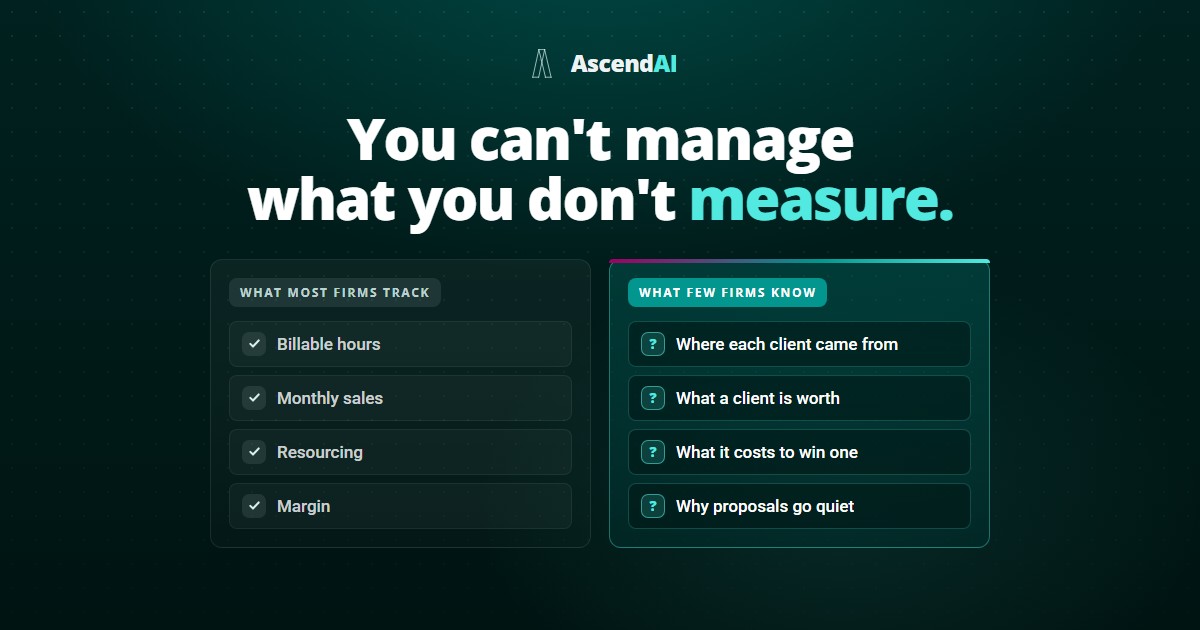
- Most firms track clients, monthly sales, resourcing and margin. That tells you how the firm did, not why, and nothing about where the next client will come from.
- Two numbers matter most: what an average client is worth over the whole relationship, net of margin, and what it costs to win one through each channel.
- Referrals feel free, but growing beyond them means paying for other channels. Even when a client takes many touches, you can still add up the cost and set it against what the client is worth.
- On our own lost deals, the person who could sign was missing from most first calls, and not one of 23 lost calls over the last few months ended with a date in the diary.
There's an old line in business: you can't manage what you can't measure. For some reason, a lot of professional and financial services firms act as if it doesn't apply to them.
That sounds harsher than I mean it. Most of these firms are run very well. But when I ask partners what a client is worth to them over the years, or what it costs them to win one, most can't tell me.
If you're a high-ticket, low-volume firm, it's tempting to think you don't need sales numbers. You do. Fewer deals means each one teaches you more, as long as you write it down.
What do most firms track?
In most firms I speak to, the monthly numbers look like this:
- How many clients we have
- Monthly sales
- Monthly resourcing
- Margin
That's a finance view. It tells you how the firm did, not why, and it tells you nothing about where the next client will come from.
A firm trying to build a sales culture needs more:
- How many meetings you have a week
- Whether those meetings are recorded, and written up the same way each time
- How many proposals go out, and how many turn into clients
- Where every deal came from: a referral, LinkedIn, the website, an event
The two numbers most firms don't know
What a client is worth
Work out your client lifetime value: what an average client pays you over the whole relationship, net of margin. If you have different service lines, work it out for each one, and then for the firm as a whole.
So many firms I speak to have never done this. It's the number every other decision depends on.
What it costs to win one
Referrals feel free. You don't pay for them; they come from good work and word of mouth. That's great, but referrals only take you so far, and growing beyond them means paying for other channels.
So track what each one costs, and what it brings in:
- Salespeople: what they cost, how many meetings they book and how many of those convert.
- Google ads: cost per click makes this the easy one.
- LinkedIn ads: tag your links, then check whether the client actually came from the ad.
- Your website and articles: harder to pin down, but tagged links show you where people arrived from.
- Conferences: the ticket, the travel and the time. Ask anyone who's been away for a week how long the catch-up takes when they get back. Is every lead from the event logged?
"It's more complicated than that"
I hear this a lot. You might meet the same firm at a conference, fly out to see them, and they read your posts for a year before they sign.
I agree it's harder to track. But you can still add it up. Say it took four conferences and a year of LinkedIn spend to win one client. Put that next to what the client is worth over the years. Was it positive or negative? Either answer tells you something.
Where do deals die?
Track why proposals go quiet. Was it a lack of follow-up? Budget? Timing? You won't always get an honest answer, but write down what you can.
When we went back through our own lost deals, two things stood out.
The first was the person who signs. In every deal we won, the person who could sign was on the first call. In most of the deals we lost, they weren't. So now, if a decision maker hands us to someone else, we push back: we need you in the room, even if it means waiting another month for the meeting.
The second was how calls ended. Not one of our 23 lost calls over the last few months ended with a date in the diary. The calls we won ended with a next step agreed that day.
We only saw both patterns because we counted every deal.
Speed matters too. How long does your team take to get a proposal out? AI should help a lot here. Keep every proposal you send, with its variations, in one place, and each new one gets quicker to build.
What does good enough look like now?
You don't need 20 salespeople. You need a few basics, and AI now makes most of them cheap:
- A CRM. It's the gut of sales. You just have to have one.
- A simple dashboard, so you can see the numbers each week.
- Targets, for you and for your people.
- Every sales call recorded and scored.
- Contact and company data filled in for you, not by hand.
Then decide where you need a person, and where a marketing or sales agent can do the job.
One habit I'd add: after every lost deal, the person who ran it records a 10-minute voice note on what happened, and it goes into the CRM. Once a week, someone reads them all and looks for patterns. Within a month or two, you'll be fixing things you didn't know were broken.
One thing to do this week
Take your last 10 proposals. Next to each one, write won, lost or silent. Then write down the last thing that happened before it stopped.
If you can't fill in that last column from memory, that's the problem this issue is about.
The bottom line
Partners track billable hours to the minute. Very few track where a new client came from. If firms put the same care into tracking sales, they'd become much better at winning work.
Referrals hide this. When the work arrives already vouched for, nobody learns to close, and nobody finds out where the website or the offer falls short with someone who doesn't know you yet. The numbers are how you find out.
Which of these could you answer today?
- What an average client is worth to you over the years
- What it costs you to win a client, by channel
- How many proposals you sent last quarter, and how many signed
- Why the last proposal you lost went quiet
Join us on 26 November
On Thursday 26 November at 09:00 UK, I'm hosting a 45-minute online roundtable for partners and leaders of professional services firms. The 19 November session is already full. I'll walk through the engine that wins clients beyond referrals, stage by stage, and where AI now does the work. Then we compare notes. Free, up to 15 places, each checked by hand.
Request a place →Originally published in Sean Winter's newsletter, as part 2 of the Beyond referrals series. Part 1: why referrals slow down.
Frequently asked questions
What sales numbers should a professional services firm track?
Beyond clients, monthly sales, resourcing and margin: meetings a week, whether meetings are recorded and written up the same way each time, proposals sent and how many become clients, and where every deal came from. Above all, what an average client is worth over the whole relationship, and what it costs to win one through each channel.
How do you work out the cost to win a client when there are many touchpoints?
Add it up anyway. If it took four conferences and a year of LinkedIn spend to win one client, put that total next to what the client is worth over the years. Whether the answer is positive or negative, it tells you something about the channel.
Why do proposals at professional services firms go quiet?
Track the reason every time: follow-up, budget or timing. In our own lost deals, the person who could sign was missing from most first calls, and not one of 23 lost calls over the last few months ended with a date in the diary. The deals we won had the signer on the first call and a next step agreed that day.

Sean Winter
Sean is a CFA charterholder with 20+ years in finance and professional services. He founded AscendAI to turn executive LinkedIn profiles into a predictable pipeline of C-suite meetings for professional and financial services firms across EMEA.