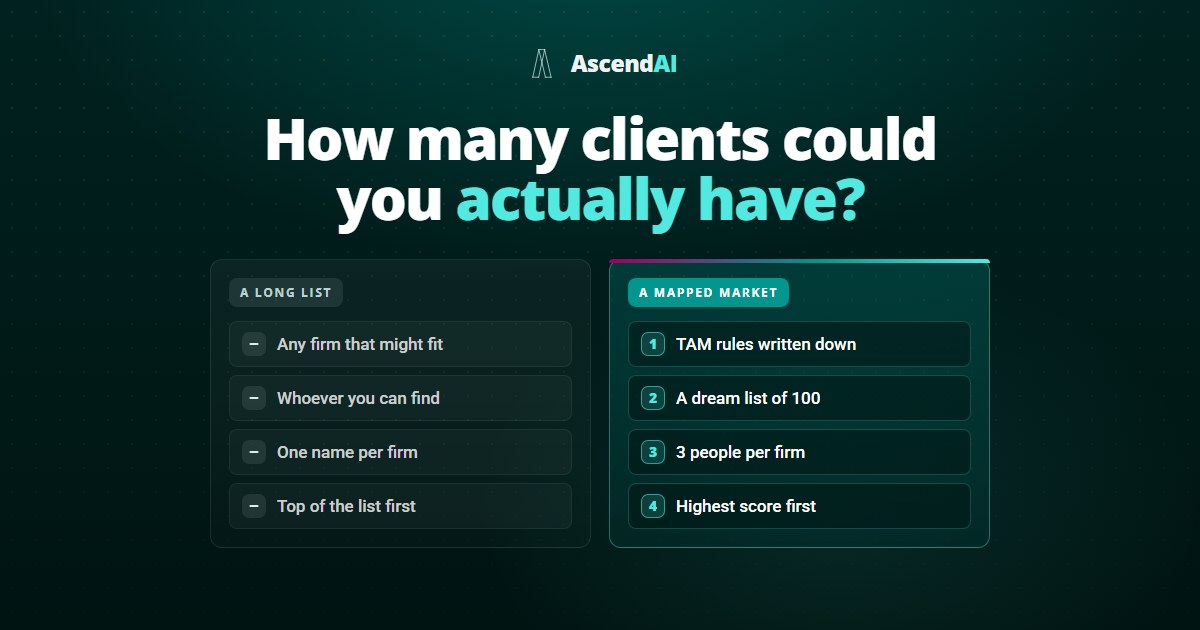
- Most professional and financial services firms can't say how many potential clients they have. Your TAM, or total addressable market, is every firm that could realistically become your client, built from a few rules: industry, size, geography and anything else that matters to you. Write the rules down, apply them, and count.
- Split the TAM into tiers: a dream list of your top 100 firms, then tier 2 and tier 3 for the rest.
- Aim for at least three people per firm. At larger firms look for a specific title; at smaller firms, the decision maker. 500 firms means about 1,500 people.
- Score everyone and start with the highest: people active on LinkedIn, in roles that reply, or new in the job.
Ask a software company how big their market is and they'll tell you straight away. How many firms fit, how big each niche is, how many players there are in each industry. They're sales businesses, so they know.
Ask a partner at a professional or financial services firm the same question and most can't answer it.
You need to know this. If referrals are going to stop being your only stream, the first step is knowing who else you could be selling to, and how many of them there are. This is step 3 of how to win clients beyond referrals: choose who to reach, and when.
What is a TAM?
TAM stands for total addressable market. Put simply, it's every firm that could realistically become your client.
Not every firm in the world, and not every firm you'd like to work with. Every firm that fits.
You build it from a few rules:
- Industries: the ones you include, and just as important, the ones you leave out.
- Size: usually by number of staff, though some firms use revenue.
- Geography: where the firm is based.
- Anything else that matters to you: keywords or rules about the company. It might be a type of client they serve, or something about how they're set up.
Write those rules down and apply them, and you get a list. Now you know how many potential clients you have.
How do you split your TAM into tiers?
Your TAM isn't one list. Stagger it.
Your dream list
This is your top 100. The firms you'd most like to work with, the ones where a single win would change your year. They get the most time and the most care.
Tier 2 and tier 3
The rest of your TAM. Still firms that fit, still worth reaching, just not where you start every morning.
Splitting it this way stops two things happening. You don't spend all your effort on firms that were only ever going to be small wins, and you don't treat a dream client like one name in a long list.
Who should you speak to at each firm?
Once you have the firms, you need the people. This is where a lot of outreach goes wrong, because the right person changes with the firm.
At larger firms you can be very specific about the title. If you sell into supply chain, you're looking for the supply chain director.
At smaller firms you usually want the decision maker. That might be any director, or it might be the CEO or the MD. Often there isn't a supply chain director at all.
Geography matters too. The same job can carry a different title in a different country, so the people you look for in one market won't always match the next.
Whatever the size, aim for at least three people per firm. One person can be busy, away or the wrong fit. Three gives you a real chance of starting a conversation.
So if you have 500 firms in your TAM, you're looking at about 1,500 people you could reach.
Who should you contact first?
Nobody messages 1,500 people at once, and you shouldn't try. The question is who to reach first.
That's where you need some kind of score. Every person on the list gets one, and you start with the highest.
A few things that push someone up the list:
- They're active on LinkedIn. Someone who posts and comments is far more likely to see your message and reply.
- They're the kind of person who replies. Over time you learn which roles answer and which don't. The ones that answer should score higher. This only works if you track it.
- They're new in the job. People who've just started are working out what to change, and they're open to new conversations.
There are other signals too, things that change at the firm itself. We watch for these every week and they feed into the score. But even the simple version above beats starting at the top of an alphabetical list.
One thing to do this week
Write your TAM rules on one page: the industries you include and exclude, the size of firm, where they're based, and anything else that matters to you.
Then try to answer two questions. Roughly how many firms fit those rules? And which 100 would be on your dream list?
If you can't put a number on the first one, that's where to start.
The bottom line
Referral firms don't need to know the size of their market, because the work finds them. Once you want to grow beyond referrals, you do.
Know your TAM. Split it into tiers. Find at least three people in each firm, and score them so you speak to the right ones first.
Which of these could you tell me today?
- How many firms fit your ideal client
- Your top 100 firms by name
- Who you'd speak to at each one
- Which of them to contact first, and why
Join us on 26 November
On Thursday 26 November at 09:00 UK, I'm hosting a 45-minute online roundtable for partners and leaders of professional services firms. The 19 November session is already full. I'll walk through the engine that wins clients beyond referrals, stage by stage, and where AI now does the work. Then we compare notes. Free, up to 15 places, each checked by hand.
Request a place →Originally published in Sean Winter's newsletter, as part 3 of the Beyond referrals series. Part 1: why referrals slow down. Part 2: you can't manage what you don't measure.
Frequently asked questions
How do I work out how many potential clients my professional services firm has?
Map your total addressable market (TAM): every firm that could realistically become your client. Write down the rules: the industries you include and exclude, the size of firm by staff or revenue, where they are based, and any other keywords that matter. Apply those rules and count the firms. Then split the list into a dream list of your top 100 and tiers 2 and 3 for the rest.
Who should I contact at each target firm?
It depends on the size of the firm and the country. At larger firms, look for a specific title, such as the supply chain director if that is who you sell to. At smaller firms, go for the decision maker: any director, the CEO or the MD. Titles also differ from country to country. Aim for at least three people per firm, so 500 firms gives you about 1,500 people.
How do I decide which prospects to contact first?
Give every person on your list a score and start with the highest. People who are active on LinkedIn, in roles you know tend to reply, or new in their job should score higher. Changes at the firm itself can feed the score too. Even a simple score beats starting at the top of an alphabetical list.

Sean Winter
Sean is a CFA charterholder with 20+ years in finance and professional services. He founded AscendAI to turn executive LinkedIn profiles into a predictable pipeline of C-suite meetings for professional and financial services firms across EMEA.