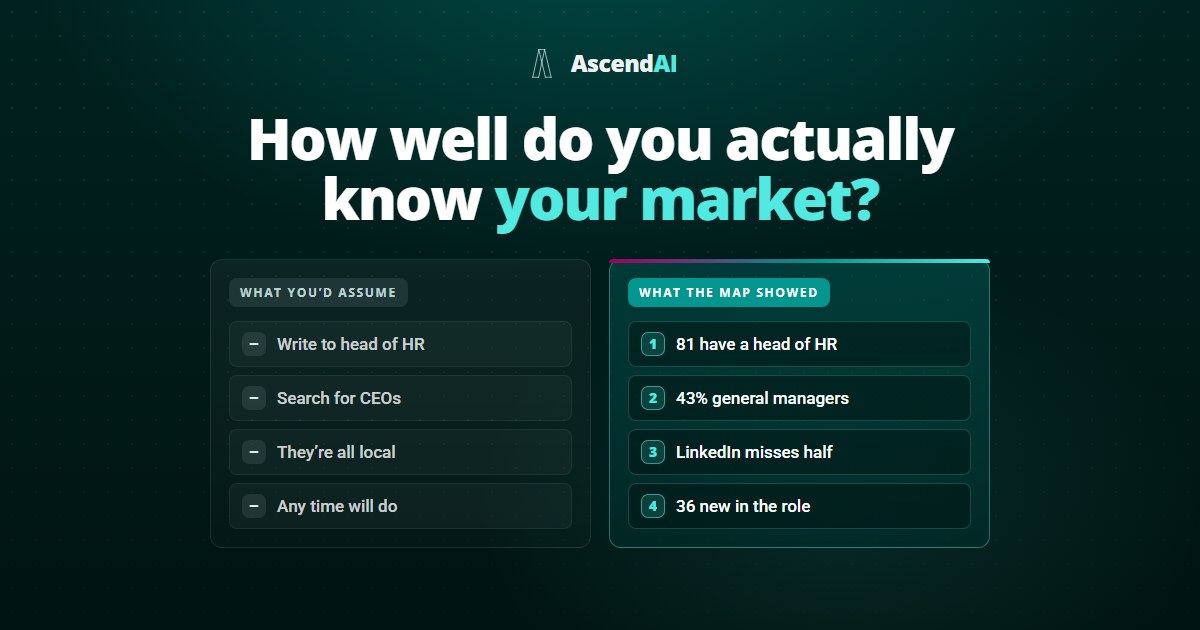
- Knowing your ideal client isn't the same as knowing your market. When we counted small and mid-size companies in one Gulf market for a GCC firm that sells HR advice, the intricacies a one-sentence ideal client misses changed who to write to, what to say and when to get in touch.
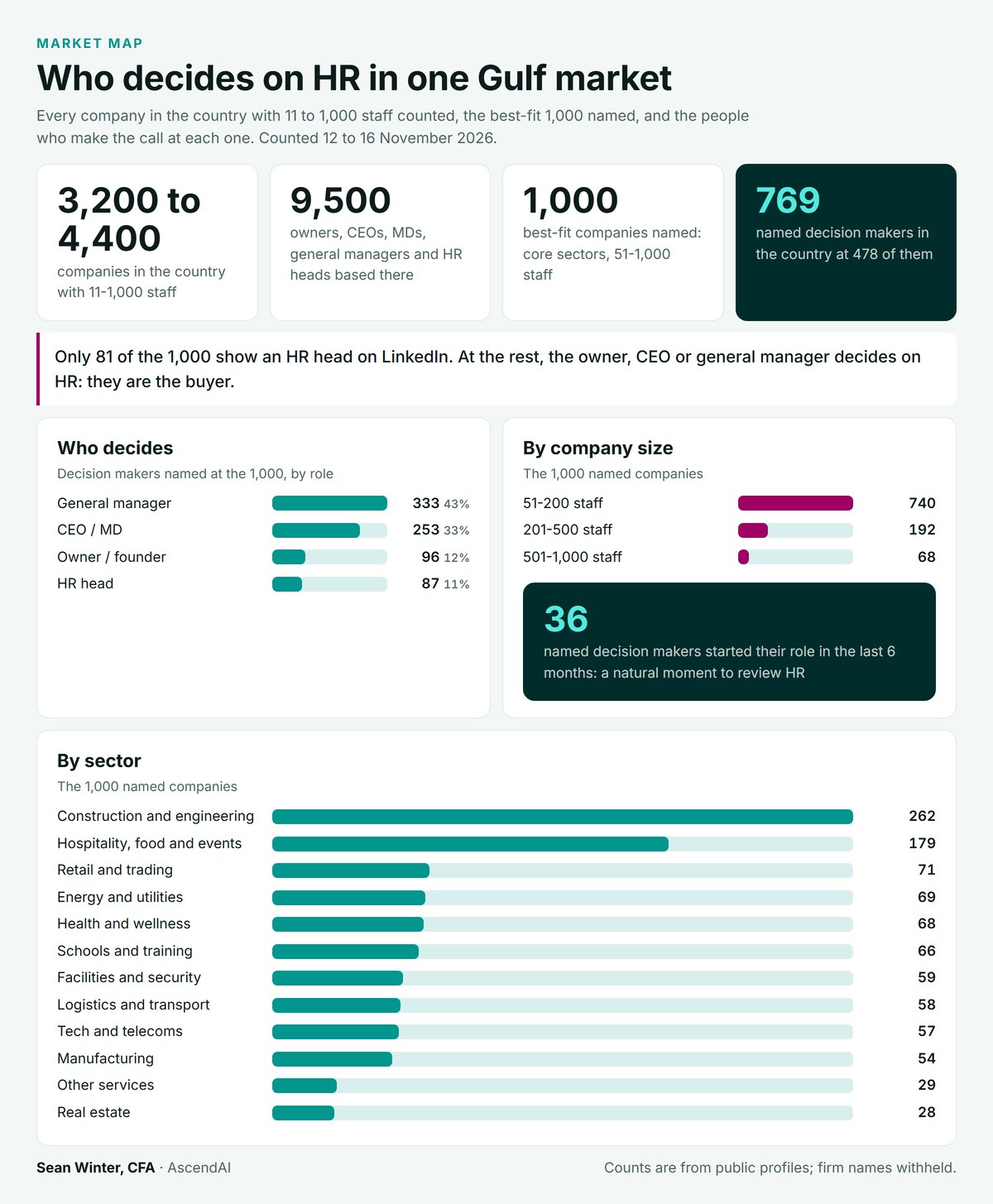
- Only 81 of the best-fit 1,000 companies had a head of HR or an HR director we could find. At the rest, the general manager, CEO or owner most likely decides, so the same service needs a different message.
- Titles change from market to market. Of 769 decision makers, 43% were general managers, a third CEOs or MDs and 12% owners or founders. At 522 of the 1,000 we found no senior decision maker based in the country at all.
- 36 of the 769 started their role in the last six months, four of them heads of HR: a reason to get in touch now rather than next year.
How well do you actually know your market? Most partners I speak to can describe their ideal client in a sentence, and they're usually right about the kind of firm. But when you sit down and count the market, there are so many intricacies that one sentence misses, and every market has its own.
In the last week we built a market map for a GCC firm that sells HR advice. Their market is small and mid-size companies in a specific Gulf market. It started with a point I'd made to them: software companies know their number, how many companies they could sell to and who decides at each one, and everyone in their sales team knows it. Most professional services firms have never counted theirs (I wrote about this in part 3), and that was true for this firm too.
So we counted it, and here's the headline:
- 3,200 to 4,400 companies with 11 to 1,000 staff
- About 9,500 owners, CEOs, MDs, general managers and HR heads based there
- The best-fit 1,000 companies named, in their core sectors with 51 to 1,000 staff
- 769 decision makers at 478 of those 1,000
The count is useful on its own, but it's the anomalies underneath it that change how you'd sell. Here are some of the things the map showed.
Who actually decides?
You'd expect a firm that sells HR advice to write to heads of HR. But only 81 of the 1,000 companies have a head of HR or an HR director we could find, and at the rest, the decision most likely sits with the general manager, the CEO or the owner.
That changes the message. A head of HR will follow you on grading, policies and compliance, because that is their job. A general manager running a 150-person construction firm thinks about cost, risk and keeping good people, and HR is one of twenty things on their desk. It's the same service, but it's a different buyer, so it needs a different message.
And that buyer is most of the market, because most of the market is small. Three in four of the 1,000 have between 51 and 200 staff.
What are the decision makers called?
In this market, the person in charge is most often called the general manager. Of the 769 decision makers, 43% are general managers, a third are CEOs or MDs and 12% are owners or founders. In part 3 I said job titles change from one country to the next, and here it is: if you'd only searched for CEOs, you'd have missed the biggest group.
The words you search with change the answer in other ways too. We counted heads of HR and HR directors but not HR managers, and adding HR managers would roughly double the HR people we found, although an HR manager isn't always the person who signs for outside advice. One of the HR directors on the starting list has their profile written in Arabic, which is a good reminder that a search in English won't find everyone.
Where do the decision makers sit?
This one surprised us. At 522 of the 1,000 we found no owner, CEO, MD, general manager or HR head based in the country, and many of the senior profiles we did find sit abroad. Either the people who decide aren't on LinkedIn, or they're in another country.
You see it in the job titles too. Even on the short list we picked to start with, several of the leaders have regional or group roles, covering the Middle East or a whole group rather than just this market, and at the international hotel chains, HR is run at group level from abroad. So for about half of this market, LinkedIn alone won't reach the person who decides, and you'll need another way in.
Who's new in the role?
36 of the 769 decision makers started their role in the last six months, and four of them are heads of HR. A new leader is usually the one who looks again at how things are done, so that gives you a reason to get in touch now rather than some time next year.
Who should you leave off the first list?
Not every company that fits belongs on the first list. When we picked a short list to start with, we chose private companies with 100 to 1,000 staff in people-heavy sectors, with a leader and a head of HR both named in the market. We took out state-linked companies, a listed developer and the international hotel chains.
The last check is one only the firm can do: which companies on the list they already work with or know well, so nobody who is already a client or a friend gets a cold message.
Does every market have anomalies like these?
None of this is unusual. Everybody has these anomalies in their market, and you only find them when you count. In yours, it might be that the managing partner signs and not the CFO, that the buyer sits in a regional office in another country, that half your targets barely use LinkedIn, or that the title you'd search for means something different over the border.
You won't see any of that from a job-title list, or from what worked with your last five clients. You see it by counting the market and looking at who's actually there.
One thing to do this week
Pick 20 companies that fit your ideal client. Next to each one, write down who would sign, what they're called and where they're based.
If you can't fill it in, or the answers surprise you, that's where to start.
The bottom line
Knowing your ideal client isn't the same as knowing your market. The intricacies decide who you write to, what you say and when you say it, and you only see them once you count.
It's also why we now spend a first meeting with a firm on its own market, which is step 5 of the start-here guide: when someone agrees to talk, show them their market.
Which of these could you tell me today?
- How many companies fit your ideal client
- Who signs at most of them, and what they're called
- How many of those people are based in the country you sell into
- How many of them you can reach on LinkedIn
- Which of them changed leader in the last six months
If some of these are still blank and you'd like your own market counted like this, book a call.
Join us on 10 December
Our 26 November roundtable is full, so the next one is on Thursday 10 December at 09:00 UK. It's a 45-minute online session for partners and leaders of professional services firms. I'll walk through the engine that wins clients beyond referrals, stage by stage, and where AI now does the work. Then we compare notes.
Request a place →Originally published in Sean Winter's newsletter, as part 5 of the Beyond referrals series. Part 1: why referrals slow down. Part 2: you can't manage what you don't measure. Part 3: how many clients could you actually have? Part 4: people don't reply to a logo.
Frequently asked questions
How do I find out who decides on buying at my target companies?
Count the market and look at who is actually there, company by company. Start from your ideal client rules, name the best-fit companies, then write down who would sign at each one, what they are called and where they are based. In one Gulf market we mapped for a firm that sells HR advice, only 81 of the best-fit 1,000 companies had a head of HR, so the general manager, CEO or owner was the real buyer.
Why do job titles matter when I search for decision makers on LinkedIn?
Because the same role has different names in different markets, and the words you search with change the answer. Of 769 decision makers we counted in one Gulf market, 43% were general managers, a third were CEOs or MDs and 12% were owners or founders, so searching only for CEOs would have missed the biggest group. Some profiles are written in another language, so a search in English won't find everyone.
What should I check before I contact a new market for the first time?
Pick 20 companies that fit your ideal client and write down who would sign, what they are called and where they are based. Then look for leaders who are new in the role, since a new leader often looks again at how things are done. Leave off the companies that don't belong on the first list, and take out anyone you already work with or know well, so no client or friend gets a cold message.

Sean Winter
Sean is a CFA charterholder with 20+ years in finance and professional services. He founded AscendAI to turn executive LinkedIn profiles into a predictable pipeline of C-suite meetings for professional and financial services firms across EMEA.