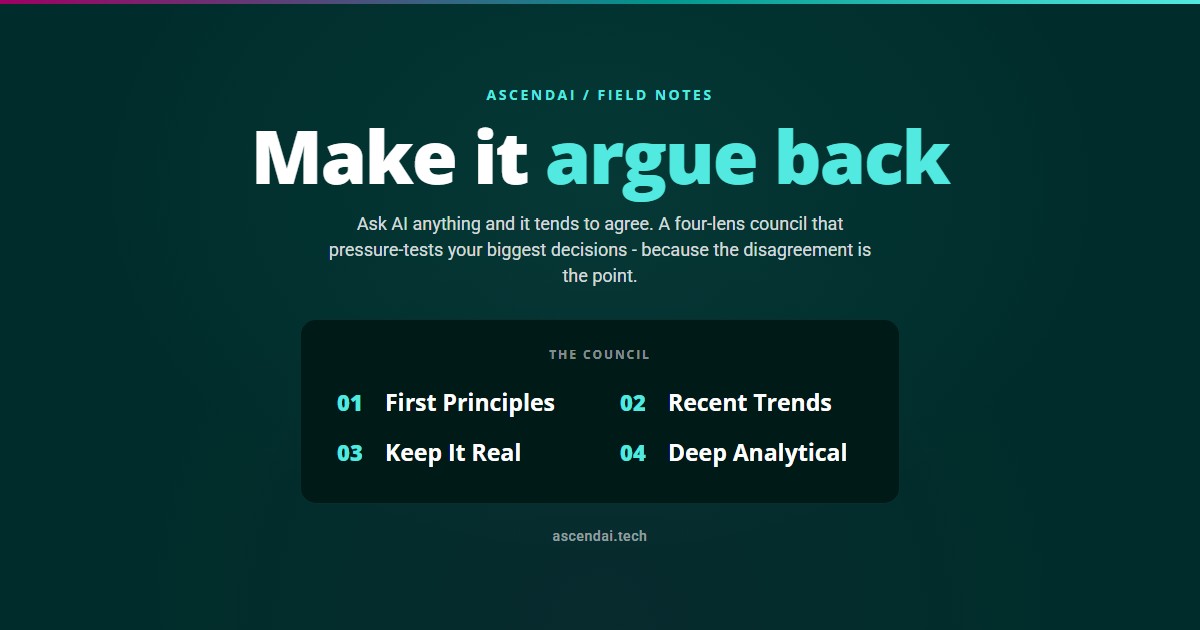
- AI is built to be agreeable - ask it about a decision and it tends to validate what you already want.
- For low-stakes work that's fine. For big, hard-to-reverse calls it's a real risk.
- The council runs one decision past four advisers with different lenses, then forces them to disagree before giving you an answer.
- The full prompt is below - paste it into any AI tool and run it on your next hard decision.
The more I lean on AI for real decisions, the more I've had to take one thing seriously: it agrees with me.
Ask it whether your strategy is sound, and it finds a way to say yes. Ask it to sanity-check your pricing, and it gives you reasons it's right. Ask whether you should take on the client that doesn't quite fit, and it helps you build the case for it.
Why AI agrees with you
It isn't lying. It's just built to be agreeable, and the way most of us ask questions makes that worse - we frame them in a way that quietly tells the model which answer we're hoping for.
For everyday tasks, none of this matters. For the decisions that actually matter - the pricing call, the hire, the pivot, the client you're unsure about - it's a real problem, and it's worth solving. This is the same instinct behind moving from AI that writes posts to AI that runs half your operations: the value shows up when the tool stops flattering you and starts doing real work.
The council: four advisers with different jobs
I first came across the idea through Andrej Karpathy. His version leaned towards technical and coding work. I was more interested in using the same idea for strategic decisions, so I built my own version of it. I call it the Council.
Instead of asking AI one question and getting one answer, you put the decision to four advisers. Each one has a different brief, and the whole point is that they're allowed to disagree.
- First Principles strips out every "this is how it's done" assumption and reasons from the ground up.
- Recent Trends asks what's changed in the last six months that bears on the decision, and whether the answer would have been different a year ago.
- Keep It Real is the BS detector. Is this genuinely what you'd do for the reason you're giving, or a rationalisation for what you already wanted? Who's being quietly ignored in the choice?
- Deep Analytical goes to the facts and the numbers, cites specifics, and - importantly - says plainly when the evidence is too thin to lean on.
Each advisor gives a verdict, their biggest concern, and one prediction you could later check.
The step that actually does the work
After the four passes, the model relabels the answers as Position 1 to 4, with the names stripped off, and critiques them as arguments alone. Where do they genuinely contradict each other? Which one is best evidenced? Which is making claims with nothing behind them?
Then it synthesises the lot into a single recommendation: what to do, the biggest risk in doing it, and the one thing that would change the answer.
Being honest about what this is
I want to be straight about it. This is one AI session playing four roles in sequence, not four separate minds in a room. The independence comes from the instructions, not from anything clever under the hood.
But it works noticeably better than asking the question once, and the reason is the cross-critique. A single answer will never surface the tension between what the data says and what your gut wants. Four briefs and a critique step force that tension into the open. And when two of the advisors land on opposite conclusions, that's not a failure - it usually means the decision is genuinely hard and you shouldn't be committing to it today. It's the same reason I think more serious professionals are getting better results out of AI: the gains come from how you structure the work, not from the tool alone.
The prompt, in full
You don't need any special software for this. Paste the block below into a long chat with whatever AI tool you already use, fill in your decision at the top, and let it run.
You're going to help me make a decision by running it past a council of
four advisers. Each reasons from a different lens. Don't blend them -
keep each one distinct, and let them disagree where they disagree.

THE DECISION:
<Describe the decision, the default path if you do nothing, and the
alternatives you're weighing.>

STEP 1 - Four advisors, one at a time.
Answer as each advisor in turn. For each, give: a verdict
(RECOMMEND / REJECT / NEUTRAL), a short paragraph of reasoning, the
single biggest risk in that direction, and one prediction that could
later be proven right or wrong.

  1. First Principles - Strip out every "this is how it's done"
     assumption. Reason from the ground up. What does the situation
     actually require, ignoring precedent and habit?

  2. Recent Trends - What's changed in the last six months that bears
     on this? Would the answer have been different a year ago? What
     makes it time-sensitive?

  3. Keep It Real - The BS detector. Is this genuinely what I'd do for
     the stated reason, or a rationalisation for what I already wanted?
     Who or what is being quietly ignored in this choice?

  4. Deep Analytical - What do the facts and numbers say? Cite
     specifics. Where the evidence is thin, say so plainly instead of
     guessing. Flag anything you're unsure of as unsure.

STEP 2 - Cross-critique.
Now relabel the four answers as Position 1 to 4, with no names attached,
and judge them as arguments only. Where do they genuinely contradict
each other? Which is best evidenced? Which makes claims with nothing
behind them?

STEP 3 - Chairman.
Read all four and the critique. Give me a single recommendation, the
biggest risk in taking it, and the one thing that would change your
mind. If two strong positions genuinely conflict, tell me the decision
isn't ready and what's missing.

Be honest. Don't smooth over the disagreement to make it tidy - the
disagreement is the point.
When to use it
Not every day, and not for the small operational stuff. I reach for it when I already have a lean and want it tested before I act, when I've been carrying an assumption for a long time without questioning it, or when something about a direction feels off and I can't say why.
It doesn't make the decision for you. It just makes it much harder to decide with your eyes closed. AI agreeing with you is the most comfortable thing about working with it, and the most dangerous. The Council is the cheapest fix I've found.
We run the engine, not just the prompts. AscendAI uses systems like this to turn executive LinkedIn profiles into three to five qualified C-suite meetings a month for professional and financial services firms. If you'd like that built for your firm, let's talk.
Schedule a call →Frequently asked questions
Why does AI agree with everything I say?
Most AI models are trained to be helpful and agreeable, and the way people phrase questions usually signals the answer they're hoping for - so the model leans towards confirming it. For everyday tasks that's fine, but for high-stakes decisions it means you get validation rather than genuine pressure-testing.
What is an AI decision council?
A decision council is a prompt that puts one decision to four different advisors inside a single AI session - First Principles, Recent Trends, Keep It Real, and Deep Analytical - each reasoning from a distinct lens. The model then critiques the four positions against each other and produces an honest synthesis, surfacing the contradictions a single answer would hide.
Do I need special software to run an AI council?
No. You can paste the council prompt into a long chat with whatever AI tool you already use, fill in your decision, and let it run through the four advisers and the cross-critique. The method is in the structure of the prompt, not in any particular software.

Sean Winter
Sean is a CFA charterholder with 20+ years in finance and professional services. He founded AscendAI to turn executive LinkedIn profiles into a predictable pipeline of C-suite meetings for professional and financial services firms across EMEA.