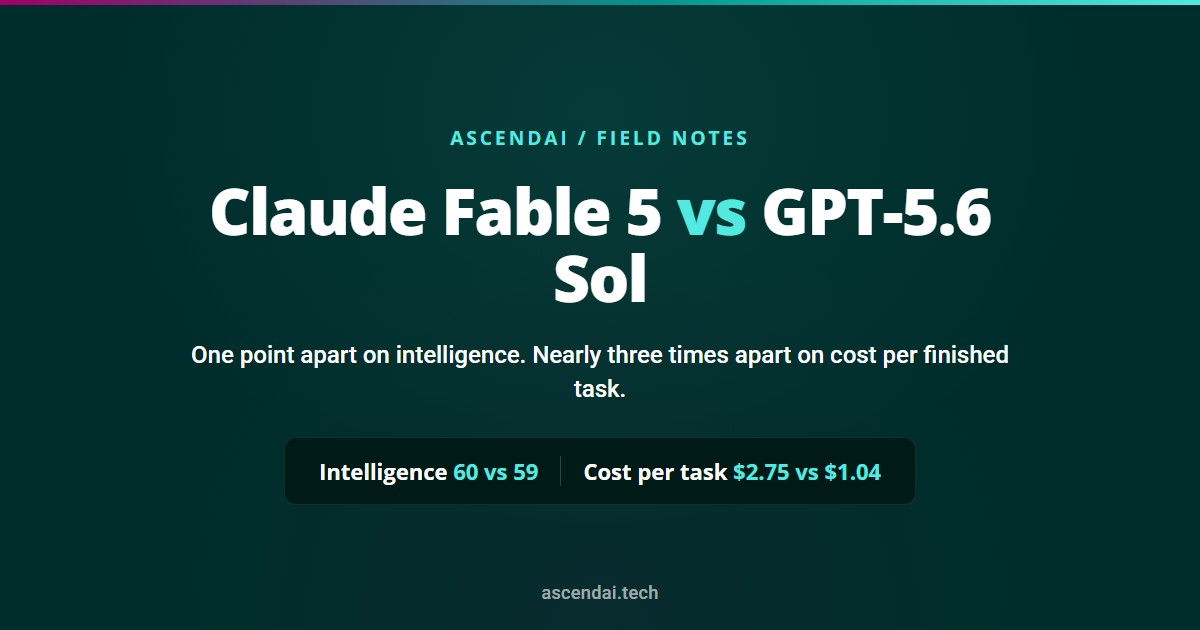
- Claude Fable 5 and GPT-5.6 Sol sit one point apart on Artificial Analysis' intelligence index, but nearly three times apart on the measured cost of finishing a real task ($2.75 vs $1.04).
- Fable thinks longer before it answers, so you pay twice: the higher rate, and all the extra thinking time. The rate card only shows the first.
- The surprise was the writing. On heavily instructed writing, Sol has clearly beaten the premium model.
- We didn't pick one. We made our setup model-agnostic and run each model where it wins.
For the past few weeks I've been paying for both of the big new AI models. Claude Fable 5, the most expensive model Anthropic has ever priced at $10 per million tokens in and $50 out. And GPT-5.6 Sol, which comes bundled with a ChatGPT subscription at no extra cost.
I wanted to know one thing. What does the expensive one actually buy you on real client work?
One point apart on intelligence, three times apart on cost
Artificial Analysis is an independent firm that benchmarks every major AI model on the same set of tests. This month they scored Claude Fable 5 at 60 on their aggregate intelligence index and GPT-5.6 Sol at 59. One point apart. Effectively level.
The cost side is where it gets interesting. On the per-token rate, Fable is roughly double Sol. But when they measured the cost of completing an actual task, start to finish, Sol came in at $1.04 and Fable at $2.75. Nearly three times, not two.
Where Fable 5's extra cost comes from
Fable 5 is the more deliberate model. It thinks longer before it answers. So you pay twice over. Once on the higher rate, and again on all the extra thinking time. The rate card only shows you the first one.
If you've spent any time in professional services, you already know this pricing structure. Nobody who buys advisory work believes the hourly rate tells them what the job costs. You ask the rate, then you ask how many hours. The number that matters is the one at the bottom of the invoice.
AI pricing works exactly the same way, and almost everyone reads the rate card and stops there.
GPT-5.6 Sol and the writing
The bigger surprise was the writing.
We do a lot of instructed writing. Not "write me a post about leadership", but proper briefs with a defined customer profile, a specific person's voice, rules about what they'd never say. It's finicky work and it's where most AI tools fall apart, because they hear the brief and then write like themselves anyway.
Sol has far exceeded Fable on this. It takes the brief and holds it, and the output sounds human and natural in a way that has kept surprising me. I expected the premium model to win here comfortably. It hasn't come close. It's a live example of the pattern we described when comparing Claude and ChatGPT for knowledge work - the leaderboard tells you less than a week of your own real work does.
Run both. Don't pick one.
So which did we choose? Neither. We changed the setup instead.
Everything we run sits inside one working environment, Claude Code. All our context lives there. The client profiles, the voice rules, the standards, the way our processes connect. That took a year to build, and it's the part that produces the value.
The model is just what's plugged into it. We built a small piece of software that runs Sol inside Claude Code, so we can swap models without touching anything else. Fable takes the hard reasoning. Sol takes the writing. Different models are better at different things, and now we can use each one where it wins.
If you don't run anything like Claude Code, there's a simpler route to the same idea. Download the ChatGPT desktop app and point it at your project folder. It works much the same way, and it gets your documents and context in front of the model instead of you pasting things into a chat box.
Two things worth taking from this
The first is how to judge these tools when someone pitches you one. Ignore the headline price. Ask what it costs to finish a real piece of your work, at your standard, done properly. That number can be nearly triple what the price list implies, and it's the only number you'll actually pay.
The second is to build your setup model-agnostic. Keep your context, your standards and your processes in one place you control, and treat the model as a component you swap. The models will leapfrog each other every few months. If your infrastructure doesn't care which one is plugged in, every leapfrog is an upgrade for you rather than a rebuild. The same discipline applies to how you make AI check its own work - we wrote about that in how to make AI argue with itself.
The bottom line
The best model and the model we use most turned out to be different models, and the deciding factor was cost per finished job, not quality. Fable 5 is superb and I still reach for it. I just reach for it on purpose now.
Test on your own work rather than a leaderboard, measure the finished job rather than the rate, and put your effort into the thing underneath. That's what survives when the models change again in three months. And they will.
Want the engine behind this, run for your firm? We use this model-per-lane setup to run executive LinkedIn programmes end to end - authority content, targeted outreach, and reply handling through to booked meetings.
Schedule a call →Frequently asked questions
Is Claude Fable 5 better than GPT-5.6 Sol?
On aggregate intelligence they are effectively level - Artificial Analysis scored Claude Fable 5 at 60 and GPT-5.6 Sol at 59 on their intelligence index. In our own client work each model wins a different lane: Fable 5 is stronger on hard, multi-step reasoning, while Sol has been clearly better at instructed writing - holding a defined voice, customer profile and style rules. The practical answer is to run each model where it wins rather than picking one.
Why does Claude Fable 5 cost more per task than its price list suggests?
Fable 5 is priced at roughly double GPT-5.6 Sol per token ($10 in / $50 out per million tokens vs $5 / $30), but it is also a more deliberate model that thinks longer before answering. You pay the higher rate on all of that extra thinking, so the measured cost of completing a real task came out near triple - $2.75 vs $1.04 in Artificial Analysis' testing. Judge AI models on cost per finished job at your quality standard, not on the per-token rate card.
Should my firm standardise on one AI model?
No - standardise on your setup, not the model. Keep your context, standards and processes in one environment you control, and treat the model as a swappable component. Models leapfrog each other every few months, so a model-agnostic setup turns each leapfrog into an upgrade instead of a rebuild. We run our whole operation inside Claude Code and plug in Fable 5 for hard reasoning and Sol for writing. If you don't run a developer environment, pointing the ChatGPT desktop app at a project folder achieves a similar effect.

Sean Winter
Sean is a CFA charterholder with 20+ years in finance and professional services. He founded AscendAI to turn executive LinkedIn profiles into a predictable pipeline of C-suite meetings for professional and financial services firms across EMEA.